
“FOCUS is a technical specification that normalizes billing data across technology vendors.”
The FinOps Open Cost and Usage Specification (FOCUS) is an open specification that defines clear requirements for technology billing data generators to produce consistent cost and usage datasets.
Supported by the FinOps Foundation, FOCUS reduces complexity for FinOps Practitioners so they can drive data-driven decision-making and maximize the business value of technology.
Learn more about the latest version, FOCUS 1.3, in this release article.
See how Max Mara Fashion uses FOCUS to unify its multi-cloud and on-premises billing data.
Learn about FOCUS and see how GitLab is using it to unify billing data across clouds and vendors.
FinOps Practitioners face a daunting challenge: collecting, normalizing, and analyzing disparate technology billing data to deliver insightful reports and recommendations that drive more business value from their technology investments.
Billing data from cloud Infrastructure-as-a-Service (IaaS) providers, platform-as-a-service (PaaS) vendors, software-as-a-service (SaaS) vendors, and other Independent Software Vendors (ISVs) streams into organizations every day, but each vendor employs unique terminology, taxonomy, and metrics in their billing file. This complexity slows a FinOps Practitioner down, as they must spend valuable time ingesting and normalizing all of this data before analysis can begin.
Using new vendors can require the adoption of new billing data schemas that must be transformed into the organization’s proprietary format. This complexity can increase the time to value for a FinOps Practitioner to get to analysis to deliver valuable insights.
FOCUS normalizes billing data from different sources, reducing the amount of work needed to begin FinOps analysis, and enabling businesses to refocus that energy on activities that are more strategic and worthwhile.
See how FinOps Practitioners are using FOCUS to ease data normalization and improve their FinOps practices.
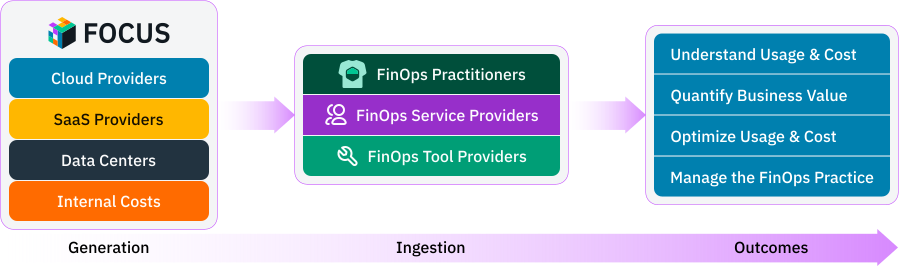
FOCUS unifies billing data from numerous sources into a single format that Practitioners, tool vendors, and service providers use to achieve FinOps Domains.
FOCUS is for two main groups of technology users: billing data generators and billing data consumers.
Generators of cloud billing data can be cloud providers or software-as-a-service companies (to name a few) that generate bills to send to customers who use their resources, tools, and/or services. For generators of billing data, the Specification is the set of requirements for FOCUS billing datasets. It defines the data that must be present in the file and how the column names must be written.
Billing data generators include, but are not limited to:
Consumers of cloud billing data are the end-user FinOps Practitioners who ingest billing datasets from technology vendors to perform FinOps activities. Billing data consumers can refer to the Specification for clarification about the definition of FOCUS Columns.
To get started, FinOps Practitioners should download their FOCUS billing data from their respective technology vendors and see what support FinOps tooling vendors currently offer. Practitioners can leverage a library of FinOps Use Cases containing predefined SQL queries that can be run on FOCUS datasets to answer FinOps questions.
Billing data generators and consumers both benefit from FOCUS being the language for technology value. No matter the role that is involved with billing data, FOCUS helps build a common ground and language for all to talk about or conduct the work that goes into a successful FinOps practice. Technology providers and tooling vendors now have a common language to position their value props and features so that their benefits are clear to the FinOps Practitioner.
FOCUS helps Cloud Service Providers, SaaS vendors, Data Cloud Platform vendors, and other Independent Software Vendors (ISVs) who generate billing data by easing adoption of technology offerings and accelerating usage of infrastructure and software.
When a billing file is in the FOCUS format, customers can readily integrate that billing data into their data pools, warehouses, and/or tooling and will already know the terminology and definitions used in the billing file. FOCUS also makes it easier for businesses to understand the ROI of (and choose a vendor that) best meets their needs.
FinOps Tooling Vendors are a subset of cloud vendors that are both generators and consumers of cloud billing data. They garner all the same benefits as other cloud vendors, with one additional benefit: more development resources. FOCUS removes the need to normalize billing data from different sources, so FinOps vendors do not need to waste development resources building data normalization functionality. Instead, those engineering resources can be spent developing support for other FinOps Capabilities with higher impact.
With FOCUS, FinOps Practitioners can learn a single process to run queries on technology billing data. This means Practitioners’ skills are more portable across technologies, FinOps tools, and organizations.
FOCUS also makes it easier for FinOps Practitioners to perform FinOps Capabilities and improves how they report the value of technology back to the business. Reducing the time and effort needed to normalize and analyze billing data enables Practitioners to refocus that energy on more important Capabilities. In other words, with FOCUS, Practitioners can spend more time on FinOps, and less time on data normalization.
This translates into a number of benefits for their organization:
See how FinOps Practitioners are using FOCUS to ease data normalization and improve their FinOps practices.
The FOCUS Steering Committee ratified the FOCUS version 1.3 specification on December 5, 2025. The improvements in this FOCUS release help satisfy these primary use cases:
Read this FinOps Insights article for more release notes.
FOCUS version 1.2 was ratified by the FOCUS Steering Committee on May 29, 2025. It helps to satisfy these use cases:
Learn about FOCUS Version 1.1.
FOCUS Version 1.1 – was ratified on November 7, 2024 . This version adds new Columns that deepen support for billing data generated by cloud service providers, giving FinOps Practitioners the ability to do more granular multi-cloud analysis on that multi-cloud data. This release also improves metadata to better support Extract Transform Load (ETL) processes, and includes normative changes for some existing FOCUS Columns.
See details of older versions via the Changelog.
The FOCUS Steering Committee and Maintainers are now engaging in roadmap development and release planning. Vendors and Practitioners can expect incremental releases over the next several years as the Specification is expanded to provide the data elements necessary to perform additional FinOps Capabilities and integrate additional types of IT spending.
